At the center of that debate is Judge John Lyke Jr., who had presided over several of Talley’s earlier cases. In December, Lyke ordered Talley released on electronic monitoring after Talley had been charged with armed carjacking and armed robbery. At the time, Talley was also connected to other cases, including possession of a stolen vehicle and battering a correctional officer.
Prosecutors opposed Talley’s release. In court, they argued that his pending cases showed he could not be safely managed through pretrial release, including electronic monitoring. Their position was that Talley’s record and open cases presented too much risk for any combination of release conditions to guarantee compliance.
Lyke still placed Talley on electronic monitoring. The judge later modified the order to allow Talley to leave home for community college and dental appointments, according to court records described in the report.
That decision is now under intense public examination because Talley is accused of carrying out a deadly attack on police officers after a separate robbery arrest.
The events that led to the hospital shooting began Saturday at a dollar store in Albany Park. Police said Talley entered the business, took a bundle of cash and repeatedly struck the clerk with a gun. The clerk suffered a broken nose, according to a police report described in the case.
Officers later tracked Talley to an alley a couple of miles away by using a GPS device that had been hidden in the stolen money. Police said the stolen cash was found in Talley’s pocket and was stained with blood. Officers also recovered the victim’s wallet, but the gun allegedly used in the attack was not recovered at that time.
After his arrest, Talley told authorities he had swallowed bags of drugs. An ambulance was called, and he was taken to Swedish Hospital. He was escorted there by officers from the Albany Park District, though they were not the same officers listed in the robbery report as the arresting officers.
What happened next has raised serious questions for investigators and the public.
Prosecutors said Talley pulled a gun from beneath a hospital blanket and opened fire on the officers. Bartholomew was fatally wounded, and the second officer was critically wounded. Talley then allegedly shot out a hospital window and fled before he was found hiding beneath a nearby porch.
One of the major unanswered questions is how Talley allegedly managed to bring a firearm into the hospital after being arrested and transported there under police supervision. The robbery report gave new details about the chain of events leading up to the shooting, but it did not resolve how the gun allegedly got past police and into the hospital.
The death of Officer Bartholomew has shaken the Chicago Police Department. He was a veteran officer with a decade of service, and his killing has intensified scrutiny of the circumstances that allowed Talley to be outside custody before the alleged robbery and hospital shooting.
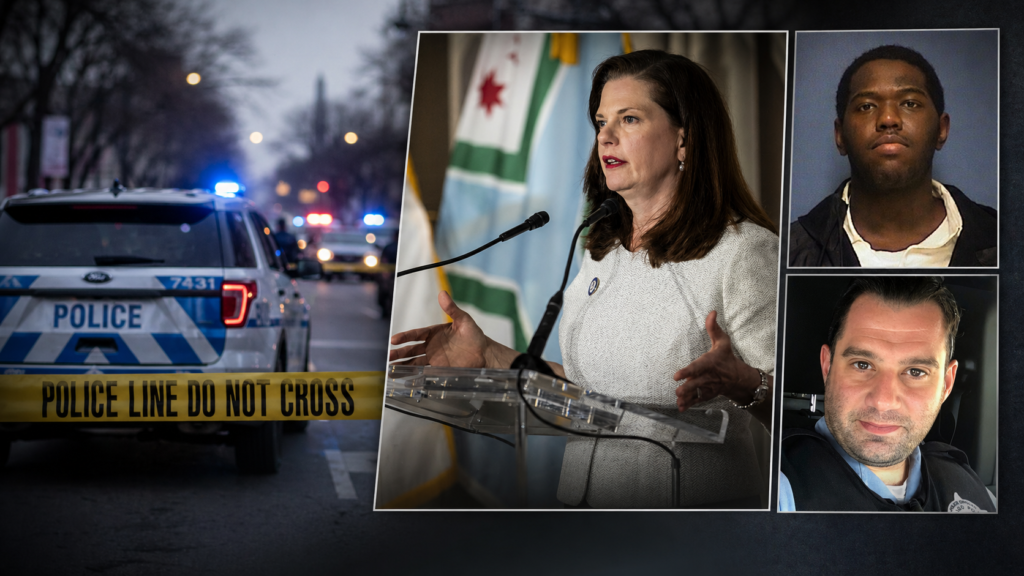
Cook County State’s Attorney Eileen O’Neill Burke said her office had presented information to the court showing why Talley should remain detained. She said prosecutors established that Talley had four pending violent felony cases, but he was still placed on electronic monitoring.
O’Neill Burke has argued that the electronic monitoring system is broken and does not keep the public safe. She said an effective system must include sworn law enforcement officers who can respond and arrest defendants when they violate the terms of monitoring. According to her, Cook County does not currently have that type of enforcement structure in place.
The criticism has focused not only on Talley’s release, but also on what allegedly happened after he was placed on monitoring.
In March, Talley missed two curfews. Days later, his electronic monitoring device turned off and did not turn back on. He also failed to appear for a March 11 court date, and warrants were issued for his arrest. He was not arrested again until Saturday, after the alleged dollar store robbery.
For some local officials, the case has become an example of what they describe as failures in the pretrial system. Illinois Comptroller Susana Mendoza criticized the decision to place someone accused of armed robbery and carjacking on electronic monitoring, saying no reasonable person should believe that such a defendant should simply be sent home on a monitor.
But advocates for bail reform have pushed back against attempts to blame the Pretrial Fairness Act, the Illinois law that eliminated cash bail. The Illinois Network for Pretrial Justice said the law did not prevent Talley from being detained while awaiting trial and argued that claims suggesting otherwise are false.
That disagreement has widened the case into a broader political and legal fight. Prosecutors and some public officials are pointing to the shooting as evidence that electronic monitoring must be strengthened. Reform advocates say the law already allowed detention and that the focus should be on court decisions and enforcement gaps rather than the elimination of cash bail itself.
Lyke had addressed Talley’s background when he released him in December. According to a court transcript described in the report, the judge acknowledged that Talley having multiple pending cases was serious and could shock the conscience in some circumstances. But Lyke also said he had seen positive changes in Talley since he first appeared before him in 2023.
The judge said he had observed attitude changes and noted that Talley had previously come into court extremely angry. That assessment is now being heavily questioned in the aftermath of the fatal hospital shooting.
Talley appeared again before Lyke on Tuesday, but only briefly. He had been expected to answer for warrants issued in his earlier cases, but the hearing was moved to a later date.
Talley is expected to face a full detention hearing Thursday. Prosecutors are expected to present preliminary facts in the shooting case, while his public defender is expected to present mitigating evidence.
The case also includes a mental health component. Talley’s mother told the Sun-Times earlier in the week that her son had long suffered from bipolar disorder and had been institutionalized. That information may become part of the defense’s presentation as the case moves forward, but it does not answer the immediate questions surrounding the shooting, the earlier release decision or the alleged failure of monitoring enforcement.
For now, investigators are continuing to examine the fatal shooting at Swedish Hospital, the violent robbery that allegedly preceded it and the unanswered security questions about how a gun allegedly reached the hospital room.
The public debate is also likely to continue. A police officer is dead, another remains critically wounded, and a defendant who had already been facing multiple serious cases is now accused in an attack that has placed Cook County’s pretrial system under renewed pressure.