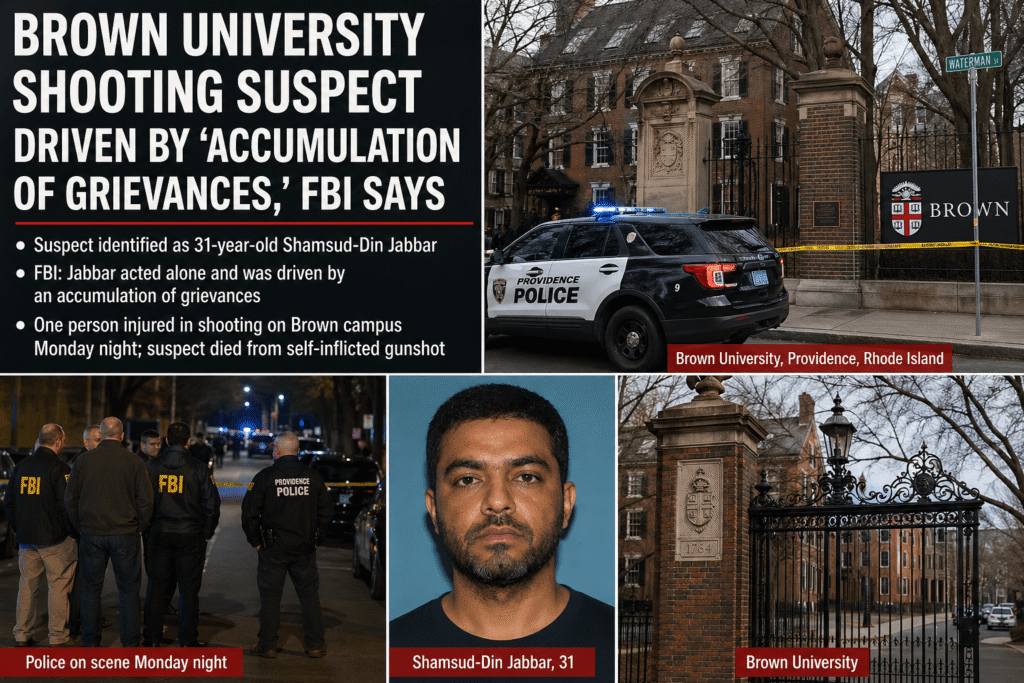
The FBI said Wednesday that the suspected gunman behind the fatal mass shooting at Brown University had spent years planning the attack and was motivated by what investigators described as an “accumulation of grievances” gathered throughout his life.
The assessment was released by the FBI’s Boston division in a joint announcement with federal prosecutors in Massachusetts after investigators completed a significant portion of their review into Claudio Neves Valente, the man authorities say carried out the December attack.
Neves Valente, 48, was a Portuguese national and former Brown University student. Authorities said he entered an engineering building on Brown’s Providence campus on December 13 and opened fire with a handgun. Two students were killed and nine others were injured in the shooting.
Investigators also said Neves Valente later killed Massachusetts Institute of Technology professor Nuno Loureiro in a separate shooting at Loureiro’s home outside Boston on December 15. Three days later, on December 18, Neves Valente was found dead from a self-inflicted gunshot wound at a storage facility in Salem, New Hampshire, after a multistate manhunt.
The FBI’s new findings provide one of the clearest public explanations yet of what investigators believe drove the attacks. Prosecutors had previously released transcripts of video recordings Neves Valente made before his death, in which he admitted planning the Brown shooting. At the time, however, authorities said he did not clearly explain why he targeted his victims.
In Wednesday’s announcement, investigators said the broader evidence now points to a long-building sense of grievance, paranoia and personal failure. The FBI said Neves Valente’s victims were “symbolic in nature” and represented what he viewed as injustices inflicted on him over time.
Federal authorities said Brown University and Loureiro both appeared to hold meaning in Neves Valente’s thinking. Investigators said the university and the MIT professor represented, to him, his personal failures and perceived mistreatment by others.
Neves Valente had attended Brown two decades earlier after completing a physics program at Instituto Superior Tecnico in Portugal. He attended that Portuguese institution with Loureiro, according to investigators. Neves Valente withdrew from Brown in 2001 and left the United States.
He later returned to the country and obtained lawful permanent residency in 2017 while living in Florida. At the time of the shootings, investigators said he was unemployed.
The FBI said Neves Valente’s “inflated sense of self” contributed to conflicts in his personal life and led him to believe he was being treated unfairly. Investigators also said they believe his paranoia increased as his failures outweighed his successes, contributing to what the agency described as his worsening mental condition and commitment to dying.
Authorities said the investigation into Neves Valente’s planning was extensive. Investigators reviewed thousands of surveillance files, analyzed 815 videos and 1,327 audio files found on his electronic devices, and conducted more than 260 interviews.
The FBI said Neves Valente stated in recordings that he began planning the attack in 2022, when he first acquired a storage unit in Salem, New Hampshire. That same city later became the place where the manhunt ended when authorities found him dead at a storage facility on December 18.
The timeline laid out by investigators suggests the attack was not spontaneous. Instead, the FBI said the available evidence shows Neves Valente spent years preparing, recording material and holding onto grievances that eventually shaped the violence he carried out.
The Brown University shooting shocked the Providence campus and drew a large law enforcement response as authorities searched for the person responsible. In the days that followed, the investigation expanded beyond Rhode Island after Loureiro was killed in Massachusetts and after federal authorities connected Neves Valente to both shootings.
Investigators have said Neves Valente acted alone. The FBI’s finding appears to rule out the possibility that other people helped plan or carry out the attacks, though authorities continued to review evidence as part of the broader investigation.
The agency’s description of the victims as symbolic is central to its explanation of motive. Rather than identifying a single immediate trigger, investigators said Neves Valente appeared to have attached broader meaning to people and institutions connected to his past. Brown, where he had once studied before withdrawing, and Loureiro, who had known him through their academic background in Portugal, became tied to the grievances he had built over time.
Federal authorities did not describe the Brown students who were killed as direct personal targets in the public summary of the investigation. Instead, the FBI said the victims were symbolic in the suspect’s mind and connected to his perception of personal failure and injustice.
The investigation also placed significant emphasis on Neves Valente’s mental state. The FBI said his paranoia increased over time and that he had become mentally unwell. The agency’s statement framed his decline as part of a broader pattern in which personal conflicts, unemployment, perceived unfairness and long-held grievances contributed to his decision to carry out violence.
Still, the FBI’s findings do not lessen the scale of the harm caused. The December shooting left two Brown University students dead and nine others injured. The later killing of Loureiro added another victim to a case that spread across multiple states and triggered an intense search before Neves Valente was found dead.
The case has now moved from an urgent manhunt into a deeper reconstruction of motive, planning and missed warning signs. Investigators have used electronic evidence, surveillance footage, recordings and interviews to understand not only what happened, but why Neves Valente chose Brown University and Loureiro as targets.
Wednesday’s announcement marks a major update in that process. It confirms that investigators believe Neves Valente spent years preparing and that his actions were driven by a long accumulation of grievances rather than a single dispute or sudden event.
For Brown University, the findings offer more detail but little comfort. The campus attack remains one of the most devastating acts of violence in the school’s recent history, and the FBI’s explanation underscores how deeply rooted the suspect’s resentment had become before the shooting.
Authorities said their review of the case included a vast amount of digital material and witness accounts, showing how much work was required to piece together the suspect’s path from former student to mass shooting suspect.
The FBI’s conclusion that Neves Valente acted alone also means the public explanation of the case now rests largely on his own recordings, digital records, personal history and the evidence recovered after his death.
Federal officials did not announce criminal charges because Neves Valente died before he could be arrested or prosecuted. The investigation instead has focused on building a full public record of the attack, the suspect’s planning and the motive investigators believe drove him.
The case remains a grim example of how long-standing personal grievances, worsening paranoia and fixation on perceived failures can culminate in targeted violence. According to the FBI, Neves Valente’s victims were not random in his mind; they represented institutions and people he associated with the injustices he believed had shaped his life.
As investigators continue closing out portions of the case, the central conclusion is now clear: federal authorities believe Claudio Neves Valente spent years preparing for the Brown University attack and acted alone, driven by grievances that had accumulated over much of his adult life.