Māori designs are meaningful visual forms connected to art, identity, nature, story, and cultural tradition in Aotearoa New Zealand.
From flowing koru shapes and bold kōwhaiwhai patterns to tukutuku panels, whakairo carving, pounamu pendants, and tā moko, Māori design is rich with meaning. Many patterns can represent growth, protection, ancestry, strength, connection, movement, and the relationship between people, land, sea, and spirit.
This guide explores Māori designs in a respectful and beginner-friendly way. It is designed to help you understand common motifs, appreciate their symbolism, and gather inspiration while remembering that many Māori designs are culturally significant and should be treated with care.
What Are Māori Designs?
Māori designs are visual forms created within Māori cultural traditions. They can appear as painted patterns, woven panels, carved forms, tattoo markings, jewelry shapes, and decorative motifs used in both traditional and modern settings.
These designs are not just decorative shapes. Many are connected to whakapapa, identity, stories, ancestors, natural forms, iwi traditions, and the relationship between people and place.
Because meanings can vary by context, region, artist, and use, it is best to approach Māori designs with respect. A pattern that looks simple may carry deep cultural meaning.
Why Māori Designs Are So Meaningful
Māori design often uses visual language to tell stories. A curve, spiral, line, or repeated pattern can suggest growth, movement, protection, genealogy, knowledge, or connection to the natural world.
Many designs are inspired by nature. Fern shoots, waves, birds, fish scales, mountains, rivers, and stars can all influence Māori art. The natural world is not treated as separate from people, but as part of a connected living world.
This is one reason Māori designs feel so powerful. They often combine beauty with story, symbol, and identity.
Respectful Use of Māori Designs
Before using Māori designs for art, tattoos, branding, fashion, décor, or digital projects, it is important to think about cultural respect. Some designs are connected to specific people, families, iwi, places, or sacred traditions.
If you are not Māori, avoid copying personal tā moko, sacred markings, or designs that belong to a specific community or family. For tattoos, many people choose kirituhi, which is Māori-style tattooing created for non-Māori wearers by knowledgeable artists.
The most respectful approach is to learn the meaning, support Māori artists, ask permission when needed, and avoid treating cultural designs as random decoration.
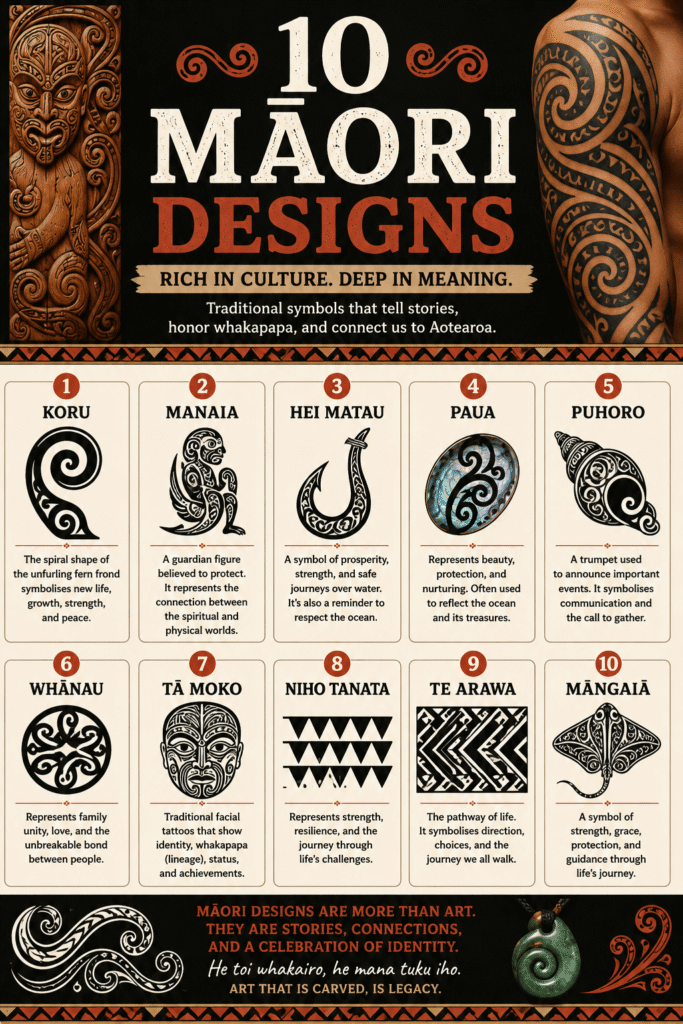
1. Koru Design
The koru is one of the most recognizable Māori design forms. It is inspired by the unfurling silver fern frond and is often associated with new life, growth, renewal, movement, and connection.
The spiral shape of the koru gives it a sense of energy and flow. It can appear in painting, carving, jewelry, tattoo-style art, textiles, logos, and wall designs.
Koru designs can be simple and minimal or layered into more complex patterns. They are often used to suggest a fresh start, personal growth, family connection, or the unfolding of a new journey.
2. Kōwhaiwhai Patterns
Kōwhaiwhai patterns are flowing painted designs often seen on meeting house rafters, waka paddles, and contemporary decorative surfaces. They usually include repeated curves, spirals, and rhythmic shapes.
These patterns often feel balanced and musical because the shapes move across the surface in a repeating flow. Red, black, and white are commonly associated with traditional visual palettes, though modern versions may use many colors.
Kōwhaiwhai can tell stories and represent ideas such as ancestry, growth, protection, knowledge, or connection. The meaning depends on the design and context.
3. Tukutuku Panels
Tukutuku panels are decorative woven panels traditionally found inside wharenui, or meeting houses. They are made with repeated geometric patterns and often sit between carved wall figures.
Tukutuku designs can represent stories, values, genealogy, stars, journeys, and relationships. Their repeated lines and shapes create a strong visual rhythm.
These panels are a beautiful example of how Māori design can combine structure, pattern, symbolism, and community effort. They are not only decorative but also part of a larger cultural and architectural setting.
4. Whakairo Carving
Whakairo is Māori carving, often seen in wood, bone, stone, and other materials. Carving can appear on meeting houses, waka, weapons, tools, ornaments, and contemporary artworks.
Whakairo often includes figures, spirals, manaia-like forms, ancestors, guardians, and intricate surface patterns. These carvings can carry stories of whakapapa, protection, status, history, and spiritual meaning.
Because whakairo is deeply connected to culture and knowledge, it should be appreciated as an art form with meaning, not simply copied as a decorative style.
5. Manaia Motif
The manaia is often shown as a spiritual guardian figure with a stylized form. It may include features that suggest a bird, human, or other symbolic creature depending on the design.
Manaia motifs are commonly associated with protection, guidance, and connection between worlds. They appear in carving, jewelry, tattoo-inspired art, and decorative design.
Because meanings can vary, it is best to learn from Māori artists and cultural sources when using or interpreting manaia imagery.
6. Hei Tiki Design
Hei tiki is a treasured pendant form often carved from pounamu. It is usually shaped as a human-like figure and can be connected to ancestry, protection, fertility, memory, and identity.
Hei tiki are not just fashion accessories. They can be taonga, or treasured objects, passed through generations and connected to family history.
If you are inspired by hei tiki forms, it is especially important to treat them with respect and understand that many carry personal and cultural significance.
7. Pounamu Design
Pounamu, also known as New Zealand greenstone or jade, is highly valued in Māori culture. It is used for pendants, tools, weapons, ornaments, and treasured objects.
Common pounamu forms include hooks, koru shapes, adze forms, toki, hei tiki, and other carved pendants. These shapes may symbolize strength, protection, connection, leadership, or personal journey.
Pounamu designs are often worn close to the body and can become deeply personal. Many people choose them as meaningful gifts, family treasures, or symbols of connection.
8. Tā Moko and Kirituhi
Tā moko is traditional Māori tattooing and is deeply connected to identity, genealogy, status, and personal story. It is not simply a decorative tattoo style.
For people who are not Māori, kirituhi is often described as Māori-style tattooing that can be created respectfully by knowledgeable artists without claiming Māori genealogy or personal whakapapa.
If you are interested in Māori-inspired tattoo design, work with a Māori artist or an artist who understands cultural boundaries. Avoid copying someone else’s moko or using sacred designs without permission.
9. Tāniko and Weaving Patterns
Tāniko is a decorative weaving technique often used in borders of cloaks and other textiles. It features bold geometric patterns and carefully repeated shapes.
Weaving is an important Māori art form that connects skill, patience, material knowledge, and cultural meaning. Harakeke, or flax, is often used in traditional weaving practices.
These patterns can inspire textile design, fashion details, wall art, and educational projects when approached respectfully and with awareness of their origins.
10. Ocean and Wave Motifs
The ocean is central to many Māori stories, journeys, and identities. Wave-like forms, flowing lines, and repeated curves can suggest movement, travel, strength, and connection to water.
Ocean-inspired Māori designs can feel dynamic and powerful. They may be used in carving, painting, tattoo-style art, jewelry, and contemporary illustration.
As with all Māori motifs, the meaning depends on the artist, story, and context. A wave pattern can be decorative in one setting and deeply symbolic in another.
Ways to Use Māori Design Inspiration Respectfully
If you are inspired by Māori designs, the best starting point is appreciation, not copying. Learn about the design, understand the meaning, and consider whether it is appropriate for your use.
- Support Māori artists and designers.
- Learn the meaning behind motifs before using them.
- Avoid copying personal tā moko or sacred patterns.
- Use Māori design references for education with care.
- Ask permission when a design is connected to a specific artist or community.
- Credit cultural sources and artists when sharing inspiration.
Respectful inspiration means recognizing that Māori designs come from living culture, not from a random pattern library.
Māori Design Ideas for Art and Learning
Māori designs can be studied in classrooms, sketchbooks, cultural projects, and art appreciation activities. The focus should be learning, respect, and understanding.
- Create a study page about the koru and its meaning.
- Learn about kōwhaiwhai patterns and their flowing shapes.
- Study tukutuku panels as examples of geometric storytelling.
- Explore pounamu pendant shapes and their symbolism.
- Research Māori artists and contemporary design work.
- Practice original patterns inspired by nature rather than copying sacred designs.
For creative projects, it is often better to create your own nature-inspired patterns after learning about Māori art, rather than copying exact traditional designs.
Modern Māori Design
Māori design continues to evolve. Contemporary Māori artists use traditional knowledge alongside modern tools, materials, and styles. Their work appears in fashion, architecture, digital art, public sculpture, jewelry, branding, painting, and tattooing.
Modern Māori design can be bold, minimal, colorful, traditional, futuristic, or deeply personal. It shows that Māori art is not only historical; it is living, changing, and powerful today.
Supporting contemporary Māori artists is one of the best ways to appreciate Māori design respectfully. It helps keep cultural knowledge visible, valued, and connected to the people who carry it forward.
Final Thoughts on Māori Designs
Māori designs are beautiful because they carry meaning, movement, identity, and story. From koru and kōwhaiwhai to tukutuku, whakairo, manaia, hei tiki, pounamu, tā moko, tāniko, and ocean motifs, each design form has its own visual power.
When exploring Māori designs, respect matters. These are not just decorative patterns; many are connected to ancestors, place, identity, and living cultural traditions.
Whether you are learning, collecting inspiration, planning a respectful art project, or simply appreciating the beauty of Māori design, take time to understand the meaning behind the forms. The more you learn, the more powerful and meaningful the designs become.