Unlike modern eagles that hunt rabbits, fish, or smaller birds, Haast’s eagle lived in a land where giant flightless birds roamed the forests and grasslands. Its main prey included moa, which were huge birds that could be many times heavier than the eagle itself.
Today, Haast’s eagle is extinct, but its story still captures the imagination. It is a fascinating example of island evolution, prehistoric wildlife, predator power, and the deep connection between animals, environment, and human history.
What Was Haast’s Eagle?
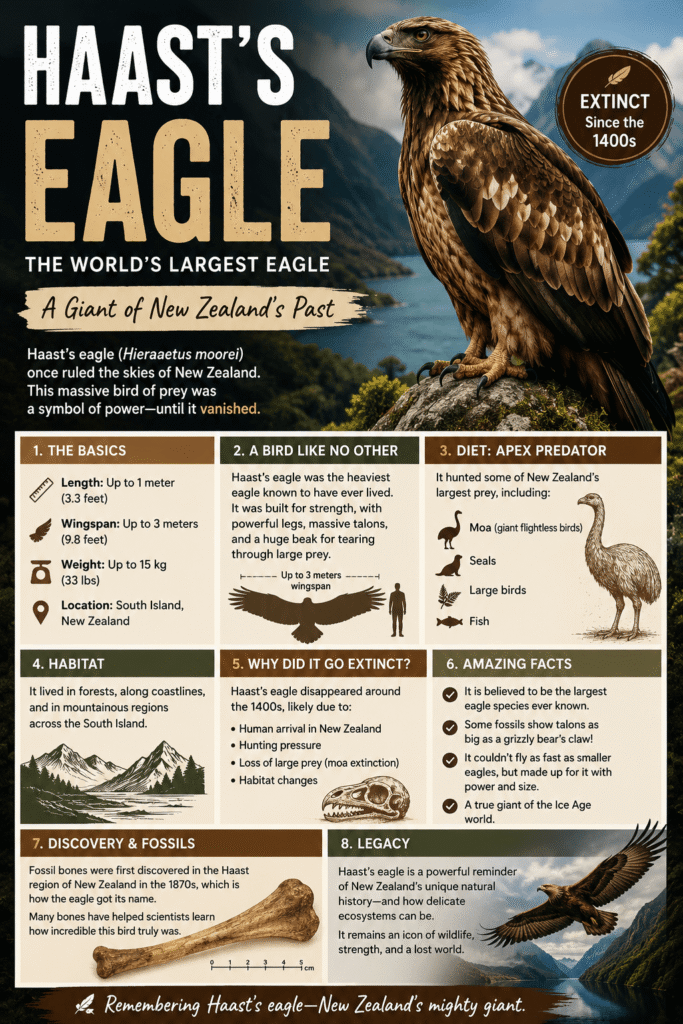
Haast’s eagle was a massive bird of prey that lived in New Zealand before becoming extinct several centuries ago. Its scientific name is often given as Hieraaetus moorei, and it is also associated with the name pouākai in Māori tradition.
This eagle was not just slightly larger than modern eagles. It was dramatically heavier and more powerful. Its body was built for attacking large prey, and its feet and talons were especially impressive.
Haast’s eagle belonged to a unique prehistoric ecosystem where birds filled many roles that mammals fill in other parts of the world. Because New Zealand had no native land mammals apart from bats before human arrival, birds became grazers, browsers, scavengers, and top predators.
Where Did Haast’s Eagle Live?
Haast’s eagle lived in New Zealand, especially on the South Island. Its world included forests, shrublands, open areas, and habitats where moa and other large birds lived.
New Zealand’s isolation helped create unusual wildlife. Many native birds evolved without mammal predators, which is one reason so many species became flightless. In that environment, Haast’s eagle became the dominant aerial predator.
Its short, broad wings are thought to have helped it move through forested landscapes. Instead of being built only for long soaring flights over open land, it likely needed power, control, and speed for hunting in varied terrain.
How Big Was Haast’s Eagle?
Haast’s eagle was enormous for an eagle. Females were larger than males, which is common in many birds of prey. The largest females may have weighed far more than the biggest living eagles today.
Its wingspan could reach around 3 metres, but what made the bird especially impressive was its weight and power. Compared with its wingspan, it was a very heavy eagle.
Its talons were huge, its legs were strong, and its beak was built for tearing flesh. These features made it capable of hunting prey much larger than itself.
What Did Haast’s Eagle Eat?
Haast’s eagle mainly hunted large flightless birds, especially moa. Moa were giant birds that could not fly and were a major part of New Zealand’s prehistoric ecosystem.
Hunting moa would have required incredible strength and precision. The eagle likely attacked from above or behind, using its powerful talons to strike with force.
Because moa were so large, one kill could provide a lot of food. Haast’s eagle may have fed on a carcass for some time, especially since there were no large land predators competing with it in the same way wolves, big cats, or bears might elsewhere.
Why Haast’s Eagle Was So Powerful
Haast’s eagle evolved in a very unusual environment. On many continents, large mammal predators dominate the top of the food chain. In ancient New Zealand, a giant eagle filled that role.
Its size likely developed because its prey was so large. When a predator depends on giant prey, it needs the strength, weapons, and hunting ability to bring that prey down.
Its claws were among its most important tools. These talons helped grip, strike, and injure prey. Combined with strong legs and a sharp beak, they made Haast’s eagle a fearsome hunter.
Haast’s Eagle and the Moa
The relationship between Haast’s eagle and moa is one of the most fascinating predator-prey stories in natural history. Moa were large, flightless birds, and Haast’s eagle was the predator that hunted them.
This connection also helps explain why Haast’s eagle disappeared. When moa vanished, the eagle lost its main food source. A specialist predator cannot easily survive when the prey it depends on disappears.
The extinction of moa changed the entire ecosystem. For Haast’s eagle, that change was devastating.
Why Did Haast’s Eagle Become Extinct?
Haast’s eagle became extinct after major changes in New Zealand’s environment and wildlife. The arrival of people brought hunting, habitat change, and pressure on large native birds.
Moa were heavily hunted and disappeared quickly. Once moa were gone, Haast’s eagle no longer had enough large prey to support its population.
Because Haast’s eagle was a top predator with specialized hunting habits, it could not simply switch to a completely different lifestyle. Without moa and other large birds, the eagle’s survival became impossible.
Was Haast’s Eagle Connected to Māori Legends?
Haast’s eagle is often connected with Māori traditions about giant birds, including the pouākai. Stories of powerful birds in the mountains and skies may preserve cultural memories of encounters with this massive eagle.
While scientific study and traditional stories use different ways of understanding the past, both help show how impressive this bird must have seemed. A giant eagle capable of hunting enormous prey would have made a deep impression on anyone who saw it.
The link between Haast’s eagle and legend adds to its mystery. It was not just an animal of science, but also a creature that lives in memory, story, and imagination.
What Did Haast’s Eagle Look Like?
No one alive today has seen a living Haast’s eagle, so scientists use bones, comparisons with modern birds, and research to understand its appearance. It likely had a strong body, broad wings, powerful legs, and a large hooked beak.
Its head and feeding habits may have been unusual compared with many modern eagles. Some research suggests it may have killed like an eagle but fed in a way that shared features with scavenging birds.
In visual reconstructions, Haast’s eagle is often shown as a huge, muscular raptor with intense eyes, massive talons, and a commanding presence. It would have been one of the most intimidating birds on Earth.
How Scientists Study Haast’s Eagle
Scientists study Haast’s eagle through fossil bones, ancient DNA, biomechanics, museum specimens, and comparisons with living birds of prey. Each piece of evidence helps build a clearer picture of how the eagle lived.
Skeletons can reveal body size, wing shape, leg strength, and hunting ability. Talons and beaks can show how the bird captured and processed prey.
Research into Haast’s eagle also helps scientists understand extinction. It shows how connected species can be, and how quickly an ecosystem can change when key animals disappear.
Interesting Haast’s Eagle Facts
- Haast’s eagle lived in New Zealand’s South Island.
- It is widely described as the largest known eagle.
- Its wingspan may have reached about 3 metres.
- Females were larger than males.
- It hunted large flightless birds such as moa.
- Its talons were extremely powerful.
- It became extinct after moa disappeared.
- It is often linked with Māori stories of giant birds.
These facts make Haast’s eagle one of the most memorable extinct birds in the world. It combines size, power, mystery, and cultural significance in a way few animals do.
Why Haast’s Eagle Still Fascinates People
Haast’s eagle fascinates people because it feels almost impossible. The idea of a giant eagle hunting birds much larger than itself sounds like something from fantasy, yet it was real.
It also reminds us that prehistoric New Zealand was unlike almost anywhere else. Instead of large cats, wolves, or bears, the top predator was a bird. That makes Haast’s eagle a powerful symbol of how unique island ecosystems can be.
Its story is also a warning. When one important species disappears, others can follow. The fate of Haast’s eagle was tied closely to the fate of the moa.
Haast’s Eagle for Kids and Students
Haast’s eagle is a great topic for kids, students, and animal lovers because it connects science, history, evolution, and storytelling. It is exciting enough to capture attention and meaningful enough to teach important lessons about ecosystems.
Students can learn about extinction, food chains, island evolution, predator adaptations, and the wildlife of New Zealand. The eagle also makes a fascinating subject for posters, reports, classroom projects, and nature study.
A simple way to understand Haast’s eagle is this: it was a giant bird of prey that lived in New Zealand, hunted moa, and disappeared when its world changed too quickly.
Final Thoughts on Haast’s Eagle
Haast’s eagle was one of the most extraordinary birds ever known. Huge, powerful, and perfectly adapted to New Zealand’s prehistoric world, it ruled the skies as a top predator.
Its story is closely tied to the moa, the ancient environment of New Zealand, and the changes that followed human arrival. When moa disappeared, Haast’s eagle lost the prey it depended on and eventually became extinct.
Today, Haast’s eagle remains a symbol of lost wildlife, natural power, and the wonder of evolution. Even though it no longer flies, its story continues to inspire scientists, artists, students, and anyone fascinated by the giants of the past.