Pride flags are more than colorful designs. They are symbols of identity, visibility, community, history, and belonging. For many LGBTQ+ people, seeing a flag that reflects who they are can feel affirming, especially in spaces where they may not always feel seen or understood.
This guide to pride flags and meanings is designed to be simple, skimmable, and helpful. Whether you are decorating for Pride Month, learning how to be a better ally, creating educational content, or simply curious about LGBTQ+ symbols, understanding these flags is a meaningful place to start.
It is also important to remember that language and symbols can evolve. Some communities use more than one flag, and individuals may connect with a flag in personal ways. This article covers some of the most recognized pride flags and the meanings commonly associated with them.
Why Pride Flags Matter
Pride flags help people communicate identity, solidarity, and support without needing a long explanation. A small flag on a desk, a patch on a jacket, or a graphic shared online can say, “You are welcome here.” That simple message can be powerful.
Flags also preserve history. Many were created by LGBTQ+ artists, activists, and community members who wanted a visual symbol for people who had been ignored, misunderstood, or pushed to the margins. Each design carries a story, and each color was often chosen with care.
For allies, learning the meanings behind pride flags is a respectful way to support LGBTQ+ friends, family members, coworkers, students, and communities. It shows that Pride is not just about rainbow decorations. It is about visibility, dignity, and the right to be fully recognized.
1. Rainbow Pride Flag
The rainbow pride flag is the most widely recognized LGBTQ+ pride symbol. It is often used to represent the broader LGBTQ+ community, pride, diversity, and collective celebration.
The original rainbow flag was created in 1978 and had more colors than the six-stripe version many people know today. Over time, the common version became red, orange, yellow, green, blue, and violet. Together, the colors represent the variety and beauty of LGBTQ+ identities and experiences.
The rainbow flag is often used at Pride parades, community centers, schools, businesses, and events. It remains a strong symbol of love, resistance, and inclusion.
2. Progress Pride Flag
The Progress Pride Flag builds on the classic rainbow flag by adding a chevron design on the left side. The arrow-like shape points forward, symbolizing progress, while its placement reminds people that more work still needs to be done.
The black and brown stripes are commonly understood to highlight LGBTQ+ people of color. The pink, light blue, and white stripes represent the transgender community. Some versions also include black as a way to honor people living with HIV/AIDS and those who have been lost.
This flag is especially popular in inclusive spaces because it visibly centers communities that have often been marginalized even within LGBTQ+ movements.
3. Intersex-Inclusive Progress Pride Flag
The Intersex-Inclusive Progress Pride Flag adds a yellow triangle with a purple circle to the Progress Pride design. This addition represents intersex people and brings more visibility to intersex inclusion within LGBTQIA+ communities.
The intersex symbol uses yellow and purple, colors often chosen because they are not tied to traditional pink-and-blue gender expectations. The purple circle is commonly associated with wholeness, autonomy, and the right of intersex people to be respected as they are.
This flag is a reminder that inclusion should continue to grow. Pride symbols can evolve as communities ask for more accurate and visible representation.
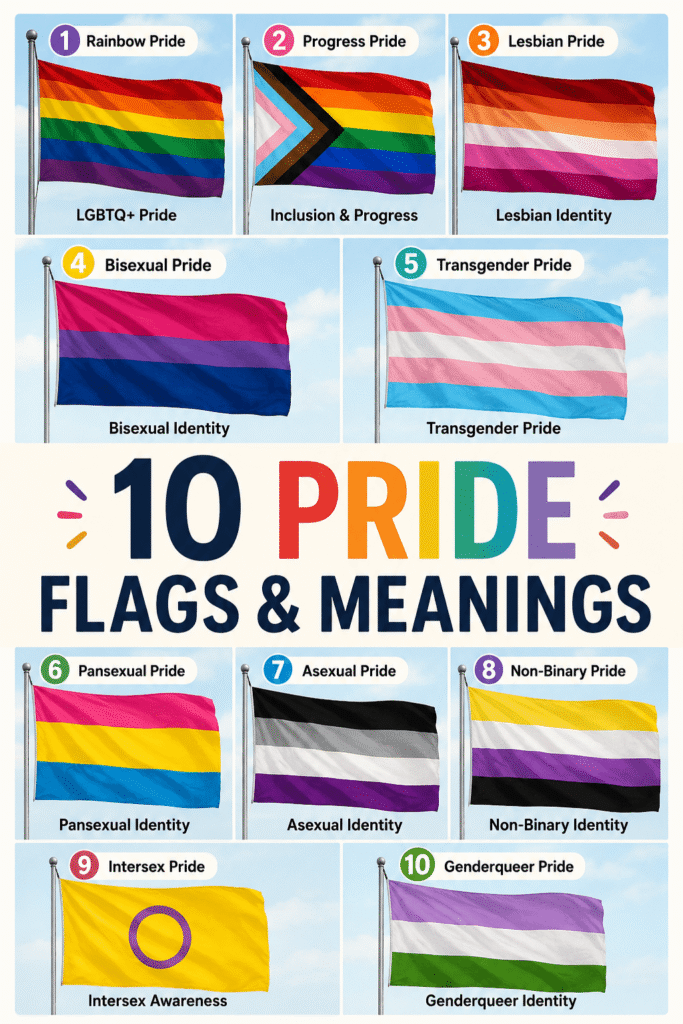
4. Transgender Pride Flag
The transgender pride flag features light blue, pink, and white stripes. It is one of the most recognizable identity-specific pride flags and represents transgender people, including trans men, trans women, and many people whose gender experience is different from the sex they were assigned at birth.
The light blue is often associated with boys, the pink with girls, and the white stripe represents people who are transitioning, intersex, gender-neutral, or outside the gender binary. The flag is designed so that it looks correct no matter which way it is flown, symbolizing finding correctness and wholeness in one’s identity.
This flag is widely used during Pride events, Trans Day of Visibility, Transgender Awareness Week, and in spaces that want to show support for transgender rights and safety.
5. Bisexual Pride Flag
The bisexual pride flag includes pink, purple, and blue stripes. It represents bisexual people, who may experience attraction to more than one gender.
The pink stripe is commonly associated with attraction to the same or similar gender. The blue stripe is often connected with attraction to different genders. The purple stripe blends the two, representing attraction across more than one gender.
The bisexual flag is especially meaningful because bisexual people can sometimes experience erasure or misunderstanding. Displaying this flag helps make bisexual identity more visible and recognized.
6. Pansexual Pride Flag
The pansexual pride flag uses pink, yellow, and blue stripes. Pansexuality is often described as attraction to people regardless of gender, or attraction where gender is not the deciding factor.
The pink stripe is commonly associated with attraction to women, the blue stripe with attraction to men, and the yellow stripe with attraction to nonbinary, genderqueer, or gender-diverse people. The flag is bright, simple, and easy to recognize.
Like many pride flags, the pansexual flag gives people a way to name and celebrate their experience. It can also help others learn that attraction and identity do not always fit into narrow categories.
7. Lesbian Pride Flag
The modern lesbian pride flag is often shown with shades of orange, white, and pink. It represents lesbian identity, community, independence, love, and connection among women and women-aligned people.
While there have been several lesbian pride flags over time, the orange-to-pink striped version has become one of the most commonly seen today. The colors are often associated with gender nonconformity, independence, community, serenity, love, and femininity.
This flag is frequently used in Pride graphics, social media posts, events, and LGBTQ+ educational materials. It celebrates lesbian visibility and the importance of lesbian history within the wider LGBTQ+ movement.
8. Asexual Pride Flag
The asexual pride flag has black, gray, white, and purple stripes. It represents asexual people, who may experience little or no sexual attraction. Asexuality exists on a spectrum, and people within the ace community may describe their experiences in different ways.
The black stripe commonly represents asexuality. Gray represents gray-asexuality and demisexuality. White can represent non-asexual partners or sexuality, depending on the interpretation. Purple represents community.
The asexual pride flag is an important symbol because asexual people are often left out of conversations about attraction and relationships. This flag helps make ace identities more visible and respected.
9. Nonbinary Pride Flag
The nonbinary pride flag includes yellow, white, purple, and black stripes. It represents people whose gender identity does not fit exclusively into the categories of man or woman.
The yellow stripe is often associated with genders outside the binary. White can represent people with many or all genders. Purple may symbolize a blend of masculine and feminine identities, and black can represent people with no gender.
The nonbinary flag is commonly used by people who identify as nonbinary, genderqueer, gender-expansive, or outside traditional gender categories. It is a clear and vibrant symbol of gender diversity.
10. Genderfluid Pride Flag
The genderfluid pride flag uses pink, white, purple, black, and blue stripes. It represents people whose gender identity may shift, change, or move across different experiences over time.
The pink stripe is commonly connected with femininity, while the blue stripe is connected with masculinity. White can represent all genders, black can represent the absence of gender, and purple can symbolize a combination of masculine and feminine energies or identities.
This flag is meaningful because it recognizes that gender is not always fixed. For many genderfluid people, the flag offers language, color, and visibility for a deeply personal experience.
How to Use Pride Flags Respectfully
Using pride flags can be a beautiful way to show support, but respect matters. Before using a flag in a product, post, event, classroom, or workplace, take time to understand what it represents. A flag should not be treated as just a trendy pattern.
When sharing pride flags online, use clear labels and avoid guessing someone’s identity based only on a flag they like. A person may use a flag because it represents them, because they support someone they love, or because they are sharing educational content.
- Learn the basic meaning before displaying a flag
- Use correct names for identities whenever possible
- Avoid using flags as decoration in disrespectful or mocking ways
- Listen when community members explain what a symbol means to them
- Remember that some flags and meanings may change over time
Pride Flags Are About Visibility and Belonging
At their heart, pride flags are about being seen. They create a visual language for people who have often had to fight for recognition, safety, and equal treatment. Each flag tells someone, somewhere, that their identity is real and that they are not alone.
Learning pride flags and meanings is a small step, but it can lead to deeper understanding. It can help make classrooms kinder, workplaces more inclusive, family conversations more thoughtful, and online spaces more welcoming.
Whether you are part of the LGBTQ+ community or an ally, these flags can be reminders of courage, joy, history, and hope. Pride is not only a celebration. It is also a commitment to making room for every person to live honestly and safely.
Final Thoughts on Pride Flags and Meanings
Pride flags are powerful because they combine color, identity, and community into symbols people can carry, display, and share. From the classic rainbow flag to the Progress Pride Flag, transgender flag, bisexual flag, pansexual flag, lesbian flag, asexual flag, nonbinary flag, genderfluid flag, and intersex-inclusive designs, each one adds something important to the larger story of LGBTQ+ pride.
The best way to understand pride flags is to approach them with curiosity and respect. Learn the meanings, honor the communities behind them, and remember that a flag can be both personal and collective. It can represent one person’s truth and an entire community’s call for visibility at the same time.